
Why Brynvara Is More Than a Fictional Town
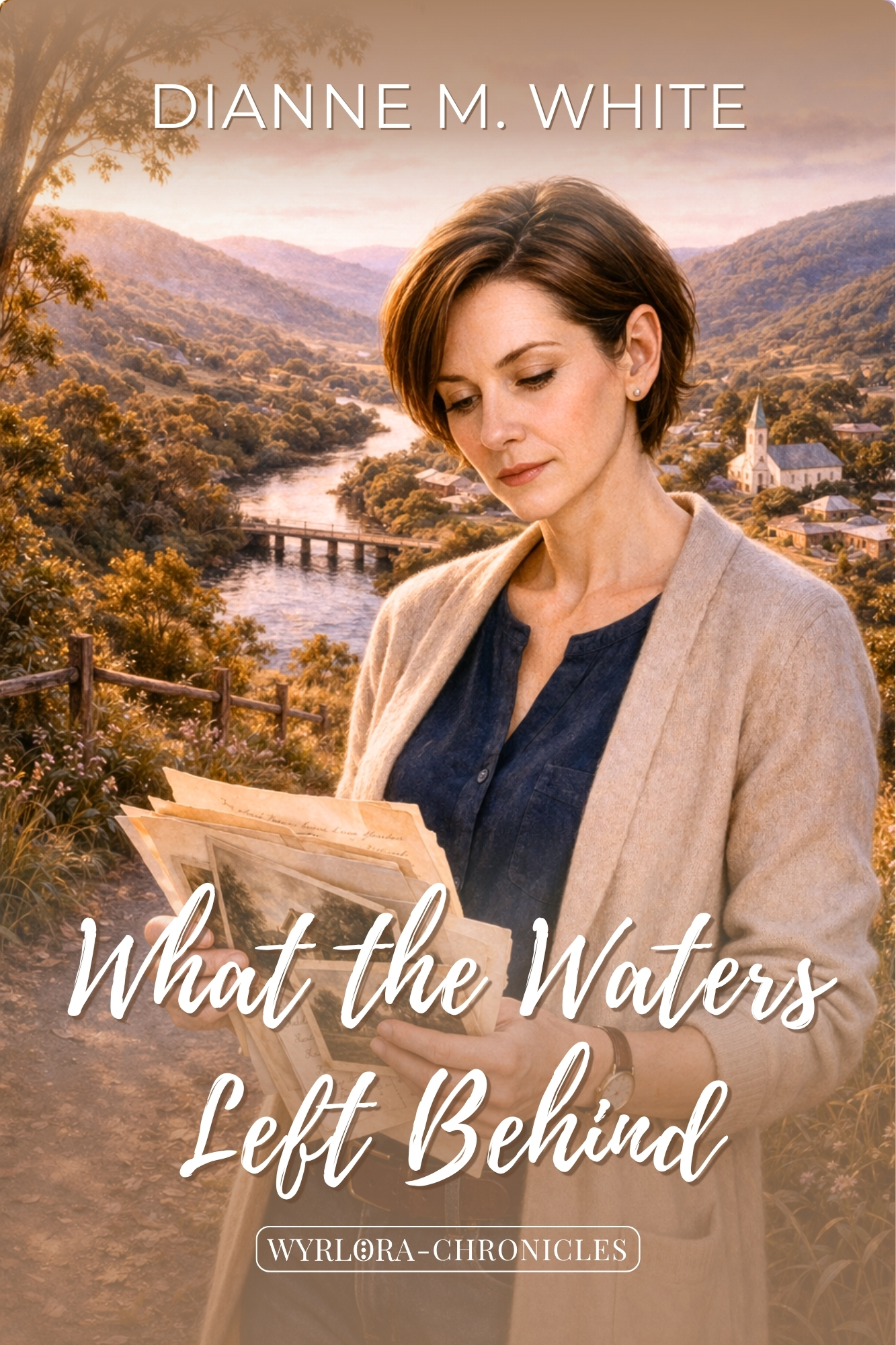
The story-world behind What The Waters Left Behind is built from memory, hidden history, ordinary kindness and the truths that rise slowly to the surface.
Every small town has two versions of itself.
There is the version visitors notice first — the main street, the café, the church steps, the old hall, the familiar faces, the pretty view from the lookout.
Then there is the other version.
The one built from memory.
The one tucked inside family names, old records, half-finished conversations, unspoken grief and the way someone’s voice changes when a certain subject comes up.
That is the version of Brynvara I wanted to write.
The town that holds the story
Brynvara is the first story-world inside The WYRLORA Chronicles, and it is where What The Waters Left Behind begins.
It is fictional, yes, but I wanted it to feel emotionally true — the kind of place readers can imagine turning into from a country road, with mountain ridgelines in the distance, river country nearby, old buildings holding their breath and a community that remembers more than it says.
Brynvara has warmth. It has practical kindness. It has people who show up with casseroles, cups of tea, working hands and strong opinions.
But it also has weight.
Long memory. Family loyalty. Church records. Memorial halls. History that has been preserved carefully in some places and avoided completely in others.
That tension is part of what makes the town breathe.
Why place matters in fiction
I have always loved stories where the setting is not just scenery.
A strong fictional place can shape the characters before they ever speak. It can hold their childhood, their regrets, their loyalties and their fears. It can explain why someone stays, why someone leaves, and why returning can feel both comforting and confronting.
Brynvara does that for Claire Rowan.
She knows the town. She knows its roads, its rhythms, its silences. But coming back as an adult is not the same as belonging as a child. The places that once felt familiar now hold questions she is not sure she wants answered.
That is one of the quiet tensions I love most in this story.
Can home still be home when it is also the place that hurt you?
The places inside Brynvara
Brynvara Memorial Hall is one of the most important places in the story. It is where old records, flood-damaged archives and town memory begin to stir. On the surface, it is practical: a building, a recovery job, damaged paper that needs restoring.
But in a town like Brynvara, paper is rarely just paper.
Beth’s Café brings a different kind of memory. It is warm, practical and human — the kind of place where people gather not only for coffee, but for news, comfort, gentle interference and the small kindnesses that keep a community stitched together.
Brynvara Church holds both comfort and consequence. Faith is part of the town’s life, but not in a neat or decorative way. It sits close to responsibility, truth, mercy and the difficult question of what people do when the past asks to be faced honestly.
And then there is the lookout — that place above the valley where distance gives perspective. Every good story needs somewhere to breathe.
Beauty on the surface, truth underneath
One of the things I find most compelling about small-town fiction is the contrast between what is seen and what is carried.
A town can be beautiful and burdened.
A family can be respected and fractured.
A church can offer comfort and still need to reckon with what was missed.
A person can seem capable, composed and dependable while quietly holding more than anyone realises.
Brynvara lets all of that live together.
It is not a town designed to be perfect. It is a town designed to be human.
Why I hope readers will want to return
My hope is that Brynvara becomes the kind of place readers do not simply visit once.
I hope it feels layered enough to return to, with people you want to understand more deeply, places that gather meaning over time, and stories that keep opening new doors.
Because The WYRLORA Chronicles is not only about one book or series. It is about a larger story-world — one where faith, memory, grief, courage, love, family secrets and healing unfold one layer at a time.
And Brynvara is where that journey begins.
If you are ready, come and step into the town.
Walk past the memorial hall. Notice the café light in the window. Pause on the church steps. Look out over the valley.
And listen carefully.
Brynvara has been holding its stories for a long time.
With warmth,
Dianne xx